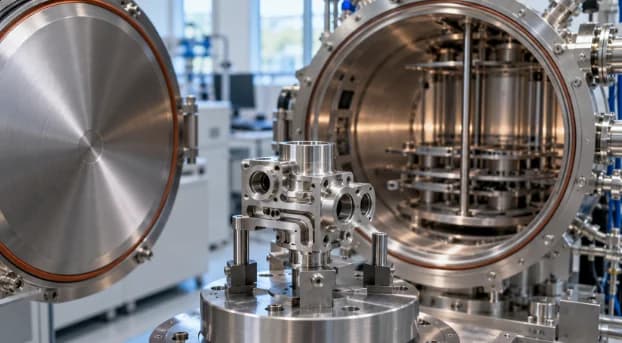
Yes, an ALD chemical barrier coating can protect a component from certain chemicals while adding only a precisely controlled, nanometer-scale film. That makes Atomic Layer Deposition a strong option for parts with tight clearances, small internal passages, detailed surface features, or dimensions that a conventional thick coating could disrupt. The coating material and process still need to match the exact chemical environment, substrate, geometry, and allowable dimensional change.
At VaporPulse Technologies, we develop custom ALD coating processes for non-standard substrates, complex geometries, prototypes, and low-volume applications. Chemical protection projects require more than choosing a familiar coating material. We evaluate what the component will contact, how long exposure lasts, which surfaces require protection, and how the finished part will be tested.
How Does an ALD Chemical Barrier Coating Work?
Atomic Layer Deposition builds a thin film through sequential, self-limiting surface reactions. The process introduces one precursor, allows it to react with available surface sites, and purges the excess. A second reactant then completes the surface reaction before another purge.
Each completed cycle adds a controlled amount of material. Repeating the cycle gradually builds the film to its specified thickness.
Because the reactions occur at the surface, a properly developed ALD process can follow contours rather than depositing material primarily on areas facing a source. Vapor-phase reactants can reach curved surfaces, recessed regions, threads, porous structures, and internal features when the geometry permits adequate exposure and purging.
The resulting film separates the underlying component from its environment. Depending on the selected chemistry, that barrier may reduce direct contact with water, oxygen, process fluids, cleaning agents, corrosive vapors, or other substances that would otherwise react with the substrate.
Chemical resistance does not come from thinness alone. The film must remain continuous, adhere to the substrate, resist the specific exposure, and stay intact during handling and operation.
How Much Does ALD Change a Component’s Dimensions?
ALD films commonly fall within the nanometer thickness range, although the required thickness varies by application. Since one micrometer equals 1,000 nanometers, a nanometer-scale film introduces far less material buildup than many paints, polymer coatings, platings, or other surface treatments.
The dimensional effect depends on where the coating grows.
A film with thickness t adds approximately t to an exposed exterior surface. If ALD coats both opposing walls of a slot or bore, the opening decreases by approximately 2t. Likewise, coating every side of a cylindrical shaft increases its diameter by roughly 2t.
For example, a 50-nanometer coating applied uniformly to both walls of an internal passage would reduce the passage width by approximately 100 nanometers, or 0.1 micrometer. Whether that change matters depends on the component’s tolerance and function.
Engineers should consider more than the nominal thickness. Critical dimensional areas can include:
- Bearing or interference-fit surfaces
- Valve seats and sealing lands
- Threads and mating features
- Electrical contact points
- Microfluidic channels
- Precision bores
- Optical surfaces
- MEMS features
- Calibration surfaces
- Connector interfaces
These areas should appear clearly on the drawing before process development begins. If a surface cannot accept any added material, the project may require selective coating, compatible masking, specialized fixturing, or a design adjustment.
ALD gives engineers unusually precise control over film growth, but it does not create zero thickness. The allowable coating buildup must remain part of the tolerance analysis.
Which Chemicals Can an ALD Coating Resist?
There is no universal ALD film that resists every chemical. Performance depends on the coating material, film structure, thickness, substrate, defect density, temperature, and exposure conditions.
VaporPulse works with ALD materials and layered systems that include aluminum oxide, titanium oxide, titanium nitride, hafnium oxide, silicon oxide, sulfides, nanolaminates, and other application-specific films. Each has different chemical and physical properties.
Aluminum oxide, for example, can work well as a barrier in many environments, but it does not remain equally stable across every liquid or pH condition. Titanium oxide or another material may perform better against a particular exposure. A nanolaminate may also combine properties that a single-material film cannot deliver.
Published research on the chemical stability of ALD alumina and titania films reinforces the need to test film chemistry against the actual fluid environment. A coating that remains stable in one solution can dissolve, hydrate, or lose barrier performance in another.
A useful chemical exposure specification identifies:
- Exact chemical name and formulation
- Concentration
- pH, when relevant
- Operating temperature
- Exposure duration
- Continuous immersion, splash, vapor, or cleaning contact
- Pressure or vacuum conditions
- Exposure frequency
- Rinse and drying conditions
- Other chemicals used before or after exposure
“Chemical-resistant” does not provide enough information for process development. “Survive repeated 20-minute cleaning cycles in a specified solvent at 45°C without corrosion or dimensional failure” gives the coating team a measurable requirement.
Why Coating Continuity Matters More Than Maximum Thickness
A thicker film does not automatically create a better chemical barrier.
Surface contamination, substrate roughness, poor nucleation, sharp edges, particles, and mechanical damage can create weak areas. If the chemical reaches the substrate through a defect, corrosion or degradation may begin beneath an otherwise intact coating.
Adding more cycles may reduce some forms of incomplete coverage, but it cannot correct every surface or adhesion problem. A damaged substrate, loose oxide, machining residue, silicone contamination, or porous deposit may prevent the film from forming a reliable barrier.
The process should establish the thinnest coating that achieves the required chemical performance with an acceptable safety margin. Excess thickness adds processing time and may increase film stress or affect sensitive dimensions without improving the result proportionally.
For components with narrow internal passages, adequate precursor exposure matters as much as cycle count. If reactants do not reach and saturate the deepest surface during each cycle, the entrance may continue gaining thickness while the interior remains undercoated. Our discussion of ALD coating inside tubes and small bores explains why geometry, exposure time, purge conditions, and verification location all affect internal coverage.
What Can Cause an ALD Chemical Barrier to Fail?
Chemical exposure represents only one part of the service environment. A film that resists the target fluid during a static laboratory test may still fail after bending, abrasion, thermal cycling, assembly, or repeated pressure changes.
Common risks include:
- Scratching or abrasion that opens a path to the substrate
- Film cracking as a flexible component bends
- Thermal expansion differences between the film and substrate
- Poor adhesion caused by contamination
- Chemical attack at exposed edges or masked boundaries
- Pinholes or incomplete film coalescence
- Substrate corrosion that begins at an uncoated interface
- Swelling or outgassing from a polymer beneath the film
- Damage during installation or later cleaning
Sharp transitions and rough surfaces deserve particular review. ALD can conform to surface texture, but coating a defect does not remove it. A deep scratch remains a deep scratch with a thin film following its shape.
The finished component also needs an appropriate handling plan. A nanometer-scale barrier cannot repair severe wear or tolerate unlimited mechanical damage simply because its chemistry resists the process fluid.

How Should a Dimensionally Critical Part Be Qualified?
Qualification should measure both chemical protection and dimensional compliance. Testing only the coating thickness leaves major questions unanswered.
Start by documenting the component’s dimensions before coating. Identify the surfaces that control fit, flow, sealing, electrical contact, optical response, or mechanical movement. Measurements should use equipment suitable for the tolerance range rather than relying on a general visual inspection.
Next, expose the coated part or a representative test sample to the actual chemical under realistic conditions. A meaningful protocol may reproduce concentration, temperature, immersion time, cleaning cycles, pressure, agitation, and drying.
Post-exposure evaluation could include:
- Dimensional measurements
- Mass-change measurements
- Optical or microscopic inspection
- Adhesion testing
- Electrical leakage or insulation testing
- Corrosion analysis
- Surface composition analysis
- Functional testing of the complete component
- Cross-sectional coating measurements
- Comparison with an uncoated control
Complex internal geometry may require witness samples or sacrificial parts placed at representative depths. An external coupon confirms that the reactor deposited a film, but it does not prove that a blind bore or internal channel received equivalent coverage.
Prototype testing also reveals interactions that material data alone may miss. The same ALD chemistry can behave differently on two substrate grades because of surface finish, alloy composition, fillers, additives, previous treatments, or contamination.
What Information Should You Provide for a Chemical Protection Project?
A strong feasibility review begins with the complete application rather than a requested film name.
Provide a dimensioned drawing and identify all critical tolerances. Include the substrate material, grade, surface finish, previous coatings, cleaning history, and any adhesives, seals, polymers, electronics, or dissimilar materials in the assembly.
The project description should also define:
- The chemical exposure and its concentration
- Exposure temperature and duration
- Acceptable dimensional change
- Areas that require coating
- Areas that must remain uncoated
- Maximum allowable process temperature
- Mechanical loading, bending, or abrasion
- Required electrical or optical properties
- Expected service life
- Available parts or coupons for testing
- The method used to determine acceptance
VaporPulse supports custom process development along with prototype, pilot, and low-volume ALD projects. This approach allows coating chemistry, thickness, fixturing, and test methods to be evaluated against the actual component before establishing a repeatable process.
Can ALD Protect Your Component Without Disrupting Its Fit?
ALD is often a strong candidate when a component needs chemical isolation and cannot tolerate a conventional micron-scale coating. Its controlled growth and conformal coverage allow an extremely thin barrier to follow detailed surfaces while preserving small features and tight clearances.
The final answer depends on the chemical, substrate, film material, geometry, tolerance, and service conditions. Film thickness must remain within the dimensional budget, and the coating must survive the complete operating environment rather than one isolated exposure.
To evaluate a part, contact VaporPulse Technologies with a dimensioned drawing, material specification, chemical exposure details, temperature limits, and acceptance criteria. We can review whether an ALD chemical barrier coating fits the component and identify the development and testing steps needed to verify it.
Our Other Blogs
september 14, 2026
How Do You Protect Polymer Components Without Plasma Damage?
september 1, 2026
How to Coat the Inside of Stainless Steel Tubes and Small Bores

august 12, 2026
Can Temperature-Sensitive Polymers Be Coated With ALD?

august 4, 2026
How to Package and Ship Prototype Parts for ALD Coating
june 30, 2026
ALD vs PVD vs CVD: Coating Guide
Subscribe to Our Newsletter
Stay up to date with our latest news, blog posts, and exclusive updates delivered right to your inbox.