ALD Coating Materials
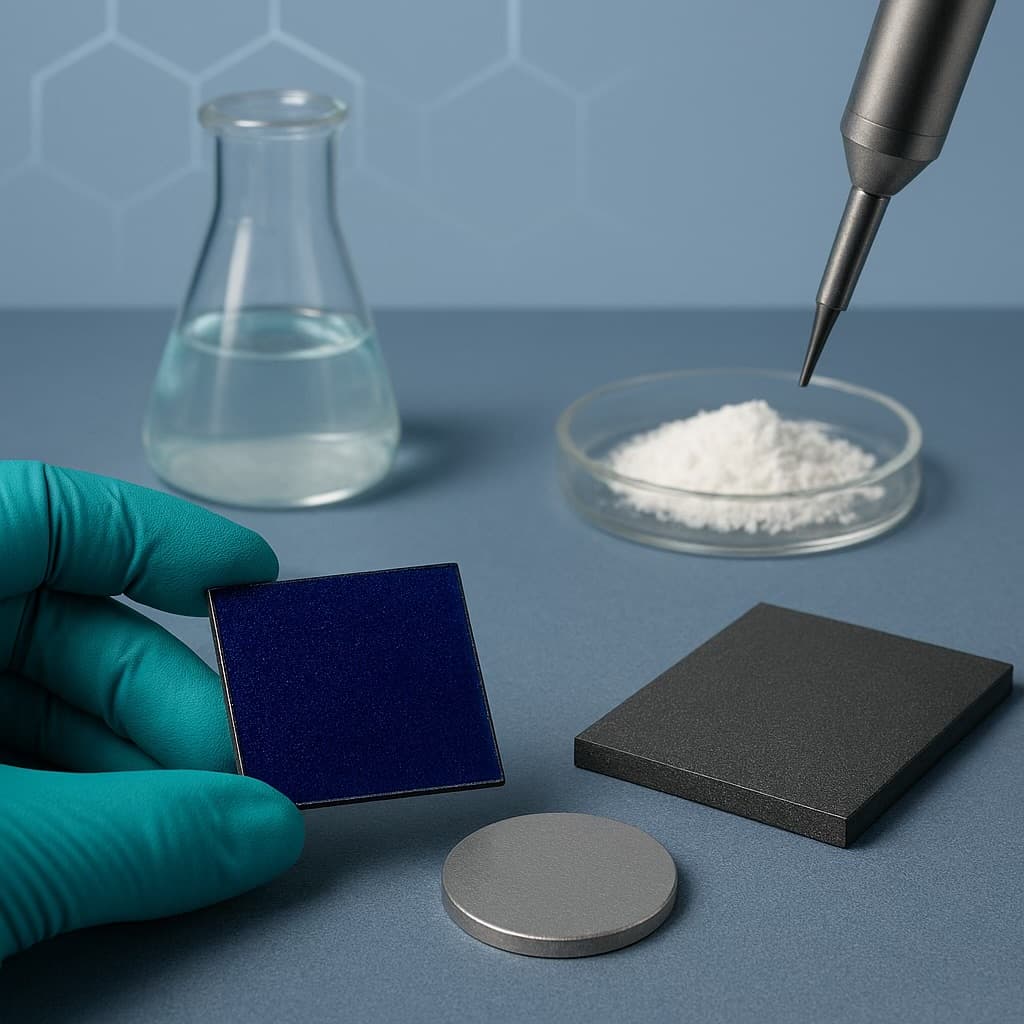
Selecting the right ALD coating material requires understanding the substrate, operating environment, and properties the final film must provide. VaporPulse works with a range of deposition materials and custom thin-film designs, including oxides, nitrides, sulfides, metals, nanolaminates, and multilayer structures. Our team evaluates coating chemistries and deposition processes to address specialized performance requirements.
We are materials-agnostic and chemistry-capable. Rather than limiting you to a fixed catalog, we develop or adapt processes for the film your application needs. Our work spans these families:
Metal oxides: Barrier, dielectric, optical, and protective films.
Nitrides: Conductive and diffusion-barrier films.
Sulfides: Functional films for specialized electronic and energy applications.
Metals: Thin conductive and seed layers.
Nanolaminates and multilayers: Engineered stacks that combine material properties.
Metal Oxide ALD Coatings
Metal oxides are the most widely used ALD films. The comparison below summarizes common materials, the properties to discuss, and typical uses.
| ALD material | Properties to discuss | Potential applications |
|---|---|---|
| Aluminum oxide (Al₂O₃) | Dielectric properties, barrier characteristics | Moisture barriers, electrical insulation |
| Titanium dioxide (TiO₂) | Optical and surface properties, chemistry-dependent behavior | Optical and functional films |
| Hafnium dioxide (HfO₂) | High dielectric constant, chemical characteristics | Dielectrics, protective layers |
| Silicon dioxide (SiO₂) | Insulating behavior, surface compatibility | Dielectric and multilayer coatings |
| Titanium nitride (TiN) | Conductivity, diffusion resistance | Functional conductive films |
| Multilayer coatings | Tunable interfaces and combined properties | Specialized protective or functional coatings |
These are general material characteristics and potential uses, not guaranteed performance specifications. Process availability, achievable properties, and deposition conditions are confirmed for each project.
Nitride, Sulfide and Metal Films
Beyond oxides, ALD can deposit nitrides, sulfides, and metals for conductive, diffusion-barrier, catalytic, and other functional roles. These chemistries often have narrower process windows, more reactive precursors, or stronger sensitivity to substrate surface conditions.
Available chemistries: Confirmed per project based on the target film and substrate.
Potential functions: Electrical conduction, diffusion barriers, seed layers, and specialized surface properties.
Development considerations: Temperature, nucleation, impurity levels, and air sensitivity. New chemistries are typically developed through our process development service.
Custom Nanolaminates and Multilayer Films
Because ALD controls each layer cycle by cycle, it can build stacks of alternating materials with nanometer-scale layers. These structures can deliver properties that no single film provides.
Layered structures: Alternating oxides, or oxides combined with nitrides, in designed sequences and thicknesses.
Interfaces: Each interface can interrupt defect paths and change how the film behaves mechanically or electrically.
Tailored properties: Tuning barrier stability, refractive index, dielectric behavior, or stress by adjusting layer ratios.
Matching Materials to Applications
Moisture barriers: Dense oxide films and multilayers. See ALD protective barrier coatings.
Dielectric insulation: Insulating oxides selected for breakdown strength and dielectric constant.
Corrosion protection: Films selected for stability in the specific environment, often with capping layers.
Other functional requirements: Conductive, optical, biocompatibility-related, and passivation layers designed around the application.
Custom Thin-Film Design
Designing a film means balancing what the coating must do with what the substrate and part can tolerate. We work through:
Thickness: Enough to deliver the function, thin enough to protect tolerances and limit stress.
Surface compatibility: Nucleation and adhesion on the specific substrate.
Process chemistry: Precursors and co-reactants that won't damage the substrate or leave unwanted residues.
Thermal constraints: Deposition temperatures that stay within the part's limits while producing good film quality.
Frequently Asked Questions
Q1. Which ALD material should I choose?
Start with the function the film must perform, such as moisture barrier, electrical insulation, corrosion protection, or conductivity, then factor in the substrate and operating environment. Aluminum oxide is a common starting point for barriers and insulation, but many applications benefit from other oxides, nitrides, or multilayers. We help narrow the options during a technical review.
Q2. Can ALD materials be deposited on any substrate?
Many substrates are compatible, but the deposition temperature, precursor chemistry, and surface condition all matter. Temperature-sensitive materials such as polymers may need low-temperature processes, and some surfaces need pre-treatment for good nucleation.
Q3. What if the material I need isn't listed?
Let us know what you need. We regularly develop or adapt processes for new materials and can tell you whether a film is feasible and what alternatives might achieve the same result.
Q4. What is a nanolaminate coating?
A nanolaminate is a stack of alternating ALD films, each only a few nanometers thick. Layering materials such as different oxides can interrupt defect paths, improve chemical stability, and tune properties like refractive index or dielectric behavior beyond what a single film provides.
Q5. Can ALD films be deposited at low temperatures?
Many ALD chemistries can run at reduced temperatures, which makes them suitable for polymers and other heat-sensitive substrates. Lower temperatures can affect film density and purity, so the process is balanced against the film properties your application needs.