What Are ALD Barrier Coatings?
When sensitive components are exposed to moisture, oxygen, corrosive chemicals, or challenging environments, coating thickness and surface coverage can be critical. VaporPulse develops custom ALD protective barrier coatings for applications requiring controlled thin-film properties, complex surface coverage, and minimal dimensional change. Coating materials and process conditions are selected around each component's exposure and performance requirements.
A barrier coating slows the movement of water, oxygen, ions, or chemicals from the environment to the surface underneath. ALD barrier films are dense, very thin, and conformal, so they can protect a part while adding very little thickness, including on edges and recessed features that other coatings may miss.
For thin films, defects matter more than nominal thickness. Pinholes, particles, cracks, and poorly nucleated regions create paths that let moisture or chemicals reach the substrate. Good barrier performance depends on surface preparation, clean processing, and a film designed to suit the environment.
Discuss Your Protective Coating RequirementsMoisture and Oxygen Barrier Coatings
Moisture and oxygen can degrade electronics, sensors, optical components, and organic materials over time. ALD oxide films can significantly reduce water vapor and oxygen transmission, and multilayer stacks can improve performance further by interrupting defect paths.
Encapsulation: Coating complete devices or assemblies to protect sensitive materials inside.
Water vapor and oxygen diffusion: Selecting films and thicknesses based on the humidity, temperature, and lifetime the part must withstand.
Appropriate testing: Transmission-rate measurements, accelerated humidity aging, or functional device testing, chosen to match how the part is used.
ALD Coatings for Corrosion Protection
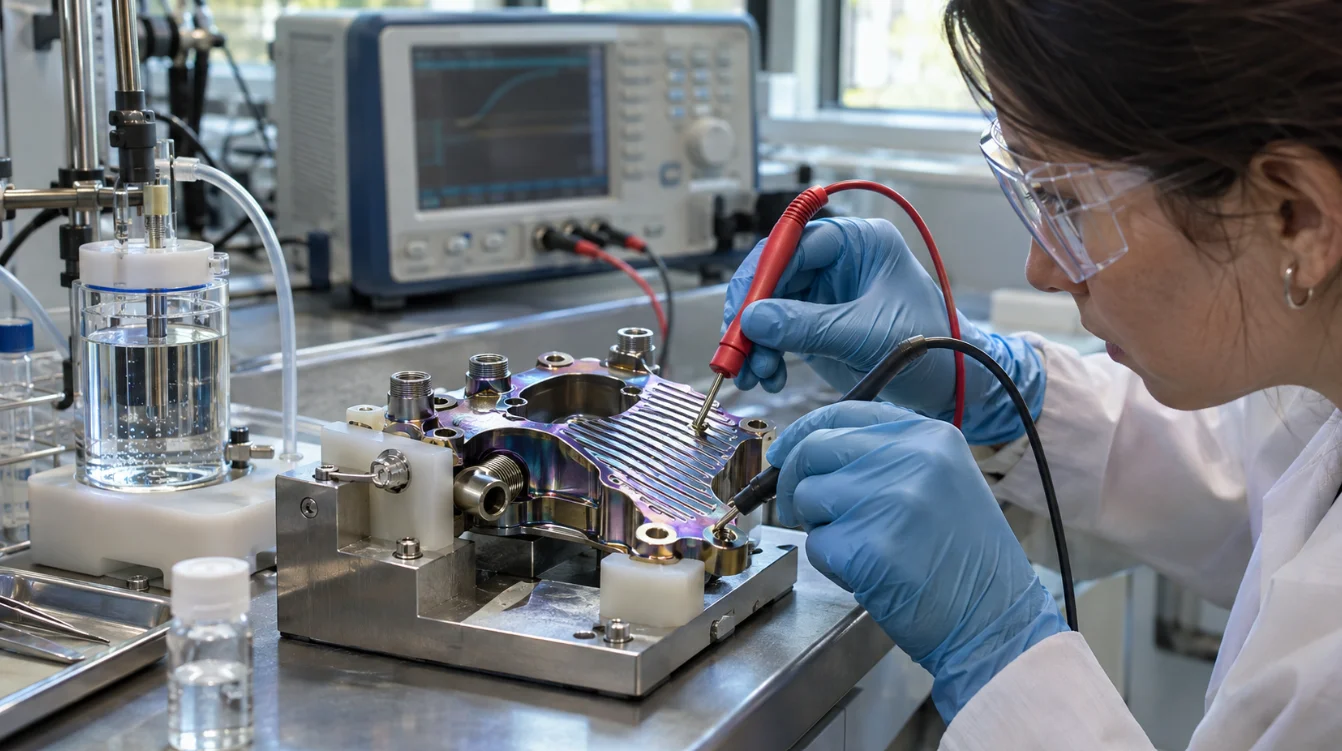
ALD films can reduce corrosion by separating a metal surface from moisture, salts, and oxidizing species, including on internal surfaces and fine features. Our article on ALD coatings for moisture and corrosion protection covers the fundamentals.
Environmental exposure: Humidity, salt spray, immersion, temperature cycling, and how long the part must last.
Material compatibility: Matching the film to the substrate so adhesion and stability hold up in service.
Corrosion mechanisms: Understanding whether the risk is general, pitting, galvanic, or crevice corrosion helps determine the right coating approach.
Chemical-Resistant ALD Coatings
Components that handle acids, bases, solvents, or process gases can benefit from a thin protective layer that doesn't change critical dimensions. Read more in Can ALD Protect Components From Chemical Exposure Without Changing Critical Dimensions?
Chemical concentration: Film stability varies with the chemical, its concentration, and pH.
Exposure duration: Brief contact, intermittent exposure, and continuous immersion lead to different film choices.
Film stability: Some single-layer films dissolve or degrade in certain chemistries, so capping layers or multilayer stacks may be needed.
Protective Coating Materials
Aluminum oxide (Al₂O₃): A widely used ALD barrier film with good moisture and gas barrier characteristics.
Titanium dioxide (TiO₂) and hafnium dioxide (HfO₂): Often used as capping or alternating layers to improve chemical stability.
Silicon dioxide (SiO₂): Insulating and chemically compatible with many surfaces.
Nanolaminates and multilayers: Alternating films that can interrupt defect paths and combine the strengths of each material.
Material choice depends on the environment, substrate, and any electrical or optical requirements. See ALD coating materials and thin-film design for more on selecting films.
Applications for ALD Protection
Sensors: Protecting sensing elements and electronics from humidity and contaminants.
Electronics: Encapsulating boards, components, and devices exposed to moisture.
Aerospace components: Thin protective films for parts where weight and dimensions are tightly controlled.
Medical technology: Barrier and protective layers for device components exposed to fluids.
Industrial devices: Corrosion- and chemical-resistant films for components with internal flow paths.
How We Evaluate Barrier Performance
Barrier performance must be proven under conditions that reflect real use. We work with you to define:
Test conditions: Temperature, humidity, chemical exposure, and duration.
Substrate preparation: Cleaning and pre-treatment to remove contaminants that cause defects.
Defect assessment: Methods to detect pinholes and gaps in coverage. See how to verify ALD barrier coating continuity.
Coating thickness: Measured on witness coupons or sectioned parts.
Acceptance criteria: Clear pass/fail measures agreed before testing begins.
No thin film is completely impermeable or corrosion-proof in every environment. ALD barriers can greatly reduce moisture, oxygen, and chemical attack, and we recommend validating each coating under your actual operating conditions.
Frequently Asked Questions
Q1. Is an ALD barrier coating completely waterproof?
No coating is perfectly impermeable in every condition. ALD films can greatly reduce water vapor and oxygen transmission, but performance depends on the film material, thickness, defect density, substrate, and environment. We recommend testing under conditions that match your application.
Q2. Will an ALD barrier coating change my part's dimensions?
ALD barrier films are very thin and highly uniform, so dimensional change is minimal and predictable. This makes ALD a good fit for precision parts, threads, and tight-tolerance features.
Q3. Can ALD protect internal surfaces from corrosion?
Often, yes. Because ALD precursors are delivered as vapor, internal channels and bores can be coated with appropriate process conditions. Coverage depends on geometry, and we review it during the feasibility stage.
Q4. What's the best ALD material for a moisture barrier?
Aluminum oxide is a common starting point, but long-term stability in humid or liquid environments is often improved with capping layers or multilayer stacks. The best choice depends on your environment and substrate.
Q5. How do you test whether a barrier coating is working?
Testing is matched to how the part is used. Options include water vapor or oxygen transmission measurements, accelerated humidity aging, salt spray or immersion testing, electrochemical methods, and functional testing of the coated device. We agree on test conditions and acceptance criteria before coating begins.