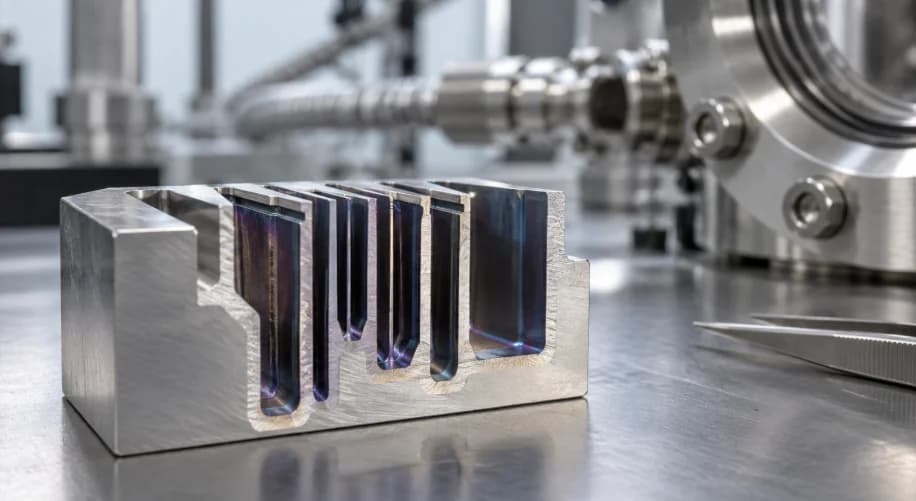
Atomic Layer Deposition (ALD) can coat deep holes, narrow channels, cavities, and other high-aspect-ratio features because vapor-phase reactants can reach surfaces that line-of-sight processes struggle to cover. But ALD does not guarantee uniform thickness throughout every feature. The precursor must reach each surface and complete its self-limiting reaction before the next process step begins. At VaporPulse Technologies, we develop custom processes for complex geometries, where feature dimensions and reactant exposure both affect the result.
How ALD coating works inside a deep feature
A typical thermal ALD cycle introduces one precursor, gives it time to react with available surface sites, and then purges the chamber. A second reactant enters and reacts with the surface left by the first half-cycle. Another purge clears the chamber before the next cycle.
Each half-reaction stops when the accessible surface sites become saturated under the process conditions. Repeating the cycle builds the film gradually, with thickness controlled largely by the number of completed cycles once stable growth is established.
Inside a narrow or deep feature, molecules must travel farther and encounter more surface area than they do on an open, flat surface. Reactant molecules can adsorb near the feature entrance before enough molecules reach the bottom. The process needs sufficient exposure for the reactant to penetrate the feature and saturate the full target surface.
That distinction explains why a coating recipe that produces consistent thickness on a flat coupon may produce a thickness gradient inside a deep cavity. ALD’s conformality comes from surface-controlled chemistry, but the chemistry still depends on reactant transport.
What affects ALD coating uniformity in high-aspect-ratio features?
Aspect ratio describes a feature’s depth relative to its opening or width. It’s a useful starting point, but it doesn’t fully describe how easy a feature is to coat. A long, straight bore, a blind hole, a branching channel, and a cavity with internal obstructions can have different transport behavior even when their nominal aspect ratios look similar.
The Aalto University review of ALD conformality discusses how gas transport, reactant exposure, sticking probability, feature structure, and measurement methods influence coating profiles. For a specific component, several connected factors matter:
- Feature depth, opening size, shape, and whether the passage has one or more gas paths
- The surface area that consumes reactant during each exposure
- Precursor properties and how readily it reacts with the target surface
- Exposure time and reactant dose
- Process temperature and pressure
- How effectively each half-cycle’s excess precursor and byproducts purge from the feature
A precursor that reacts quickly near the opening can be depleted before it reaches deeper surfaces. A longer exposure or higher dose may improve penetration, but the useful conditions depend on the chemistry and geometry. Increasing exposure also affects cycle time, and it does not resolve every source of nonuniformity.
Temperature matters because it affects reaction kinetics, precursor transport, and film growth. The process must stay within a suitable window for the chemistry and the component. If the temperature or exposure conditions encourage condensation or decomposition, the process can depart from the intended self-limiting growth behavior.
Why purging matters inside channels and cavities
A purge removes excess reactant and reaction byproducts before the next precursor enters. Deep or restricted features can take longer to clear than open surfaces because gas must travel into and out of the feature.
If the purge is too short, residual reactant can overlap with the next half-cycle. That overlap can cause unwanted gas-phase reactions or growth that no longer follows the intended ALD cycle. Purge conditions therefore matter alongside precursor exposure: reactants need time to enter, react, and leave in a controlled sequence.
Blind holes and enclosed cavities deserve particular attention. Their gas path may be restricted to a single opening, while connected channels may have branches or changes in cross-section. A process review should account for how gas enters and exits the actual part, not just its outside dimensions.
Thermal ALD and plasma-enhanced ALD can behave differently
Thermal ALD relies on thermally driven surface reactions. Plasma-enhanced ALD (PEALD) uses plasma-generated reactive species during part of the cycle. Those species can support film chemistries or process temperatures that a thermal route may not achieve under the same conditions.
The choice can also affect penetration. Plasma-generated radicals may recombine as they travel along surfaces, which can reduce the amount that reaches the deepest regions in some geometries. That does not make PEALD unsuitable for every high-aspect-ratio feature. Results depend on the chemistry, plasma configuration, exposure conditions, and reactor design.
For a deep internal feature, the process developer should consider both the required film properties and how each reactant reaches the target surfaces. VaporPulse’s complex-geometry ALD coating services include work with high-aspect-ratio structures, internal features, and non-flat parts.

How do engineers check coating coverage at depth?
A thickness measurement on the outside of a part or on a flat witness coupon confirms that film growth occurred in the reactor. It does not establish that the deepest point in a channel received the same thickness.
A useful verification plan identifies where the coating needs to work and measures representative locations along the feature. Depending on the part and project, that may involve sectioning a sacrificial component, placing representative test surfaces at different depths, or using a suitable cross-sectional or compositional analysis method. The acceptance criteria should state which regions matter and what variation the application can tolerate.
An application-specific performance test can answer a different question from a thickness measurement. For example, if a coating needs to isolate a substrate from a chemical, testing the actual exposure can show whether the coated part meets the functional requirement. The required test depends on what the film must do.
What information helps evaluate a complex feature?
A dimensioned drawing gives the process team a practical starting point. Include the feature opening and depth, changes in cross-section, blind or branched passages, and the surfaces that need coating. Note any regions that must remain uncoated.
Also describe the substrate, maximum allowable process temperature, intended film function, operating environment, and the method you’ll use to judge success. If possible, identify a representative test part or sacrificial component for process development and coverage checks.
These details help connect the geometry, chemistry, and verification plan before processing begins. For a project involving deep holes, channels, or cavities, contact our team with the part drawing and coating requirements. We can review the feature geometry and discuss whether a custom ALD process merits evaluation.
Our Other Blogs

october 17, 2026
Thermal ALD vs Plasma ALD: How Does the Process Differ?

october 6, 2026
Can ALD Protect Components From Chemical Exposure Without Changing Critical Dimensions?
september 14, 2026
How Do You Protect Polymer Components Without Plasma Damage?
september 1, 2026
How to Coat the Inside of Stainless Steel Tubes and Small Bores

august 12, 2026
Can Temperature-Sensitive Polymers Be Coated With ALD?
Subscribe to Our Newsletter
Stay up to date with our latest news, blog posts, and exclusive updates delivered right to your inbox.