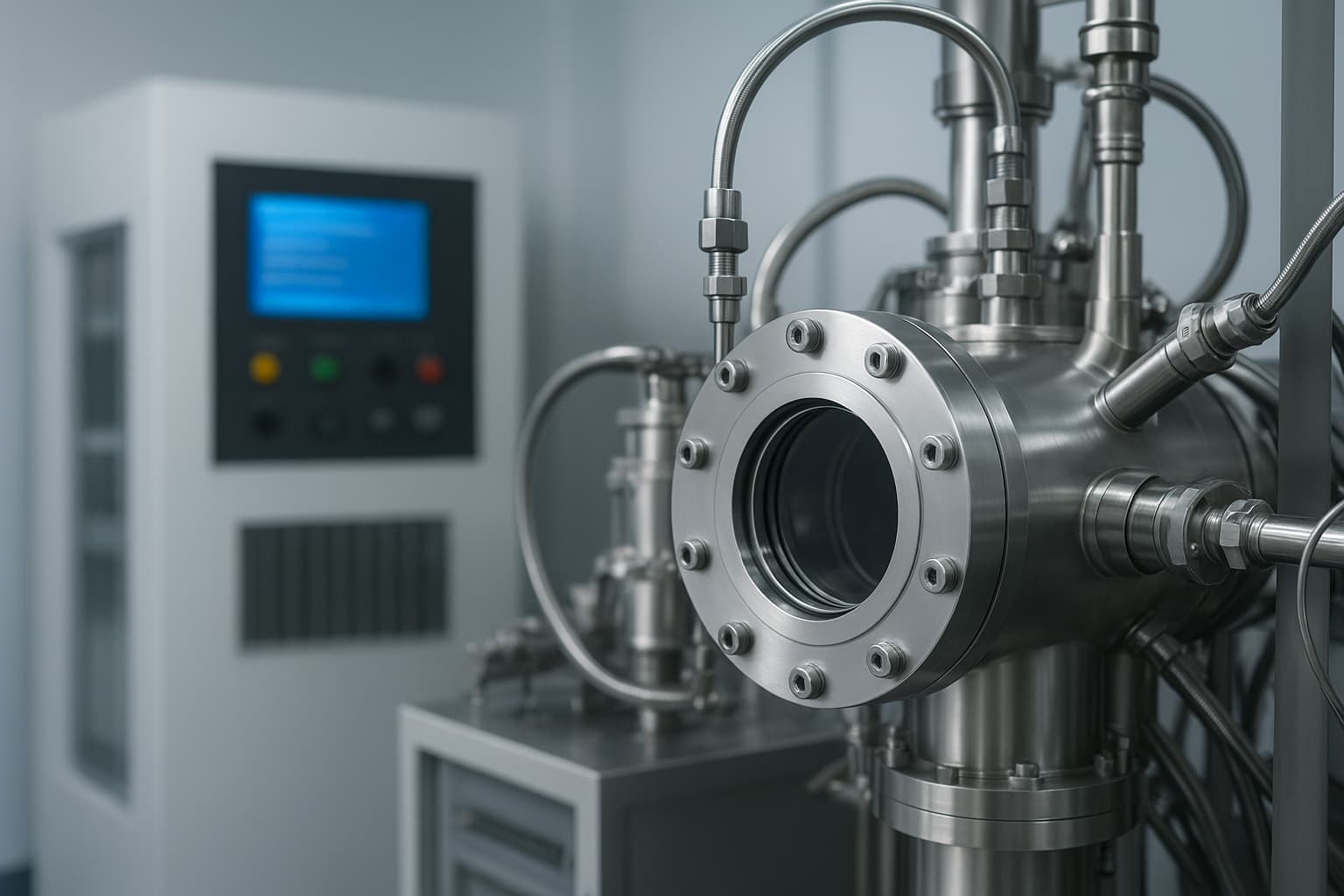
Custom Atomic Layer Deposition Services
VaporPulse provides custom Atomic Layer Deposition (ALD) coating services for components that require precise film thickness, conformal coverage, and specialized material properties. From early-stage prototypes to pilot production, our team works with engineers and researchers to develop coating solutions for complex geometries, delicate substrates, and demanding operating environments.
Our ALD coating service is built for parts that don't fit a standard process. Instead of selecting from a fixed menu, we start with your component, your substrate, and the performance the film must deliver, then develop or adapt a deposition process around those requirements.
What the service includes: Technical review of your part and requirements, process selection or development, sample and prototype coating, and support for low-volume and pilot runs.
Who we work with: Engineers, researchers, and product developers at startups, OEMs, defense and aerospace programs, medical device companies, energy storage teams, and university labs, particularly groups that need ALD without investing in in-house tooling.
How projects begin: Most projects start with a short conversation about the part, the substrate material, the desired film, and how the coating will be tested. From there we confirm feasibility and propose a path to sample coating.
Alongside thermal ALD, our team also works with Molecular Layer Deposition (MLD) and modified Chemical Vapor Deposition (CVD) approaches when a project calls for hybrid organic-inorganic films or a different deposition regime.
Request a Custom ALD Coating QuoteWhy Choose ALD for Your Component?
ALD builds a film through repeated, self-limiting surface reactions. Each cycle adds a fraction of a nanometer, so total thickness is set by the number of cycles rather than by line-of-sight exposure or deposition time. For an introduction to the chemistry, see What Is ALD and Why It Matters.
Conformality: Because precursors arrive as vapor and react only with available surface sites, ALD can coat trenches, pores, edges, and the far side of a part with similar thickness.
Nanoscale thickness control: Thickness is controlled cycle by cycle, which allows very thin, repeatable films that add minimal dimensional change to precision parts.
Internal features: With appropriate exposure and fixturing, ALD can reach internal channels and bores that line-of-sight methods cannot. Learn more on our complex geometry ALD coating page.
Where ALD may outperform alternatives: PVD is line-of-sight and CVD can struggle with thickness uniformity on intricate surfaces. ALD is often the better fit when coverage and thickness precision matter more than deposition speed. Our ALD vs PVD vs CVD guide compares the trade-offs in detail.
ALD is not the right answer for every part. Thick films, very large batch volumes, or applications that only need coverage on exposed flat surfaces may be better served by other methods, and we will tell you if that's the case.
ALD Coating Materials and Substrates
We work across several film families and develop new chemistries when a project requires it. Detailed properties and selection guidance are on our ALD coating materials and thin-film design page.
Metal oxides: Including Al₂O₃, TiO₂, HfO₂, and SiO₂.
Nitrides: Including TiN for conductive and diffusion-barrier applications.
Sulfides and metals: Developed or adapted for specific functional requirements.
Nanolaminates and multilayers: Alternating films that combine properties or improve barrier and stability performance.
Common substrates include metals, ceramics, glass, silicon, polymers, porous media, and additively manufactured parts. Substrates with low temperature limits, outgassing behavior, or unusual surface chemistry are reviewed for feasibility before coating so we can confirm compatibility with the process temperature and precursors.
ALD Coating Capabilities
Prototype runs: Coat a small number of parts or coupons to evaluate film performance before committing to a larger build.
Process development: Develop or tune a process for a new substrate, chemistry, or geometry. See ALD process development and prototyping.
Custom coatings: Single films, nanolaminates, and functional stacks including protective barrier coatings for moisture, corrosion, and chemical exposure.
Low-volume and pilot work: Repeat coating runs for pilot builds, qualification lots, and limited production.
Low-temperature and plasma-free options: Thermal processes tuned for polymers, organics, and other temperature-sensitive parts.
Our ALD Coating Process
- 01
Inquiry
Share your part, substrate, desired film, quantities, and timeline. Drawings or photos help us respond faster.
- 02
Technical evaluation
We review material compatibility, temperature limits, geometry, and the properties the coating must deliver.
- 03
Process development
If an established process doesn't fit, we adjust chemistry, temperature, exposure, and fixturing for your part.
- 04
Sample coating
Initial parts or witness coupons are coated so thickness and film quality can be checked.
- 05
Validation
You test the samples against your application requirements, and we refine the process based on the results.
- 06
Production planning
Once the process is proven, we plan repeat runs for pilot or low-volume production.
Industries and Applications
Aerospace and defense: Protective and functional films for components exposed to demanding environments.
Medical devices: Thin, conformal coatings for device components where dimensions and surface properties matter.
Electronics and sensors: Dielectric, passivation, and encapsulation layers for sensitive parts.
Energy storage: Surface coatings for electrode materials, powders, and cell components under development.
Industrial R&D: Feasibility work and prototype coatings for new products and materials.
Frequently Asked Questions
Q1. How much do custom ALD coating services cost?
Pricing depends on the substrate, film material, target thickness, part geometry, fixturing needs, quantity, and whether a new process must be developed. Projects that use an established process cost less than those requiring development. We provide a project-specific quote after a short technical review.
Q2. What is the typical turnaround for ALD coating?
Turnaround depends on whether a suitable process already exists, how many parts are involved, and how much development or testing is needed. We confirm the expected timeline in your quote and keep you updated throughout the project.
Q3. Which substrates are compatible with ALD?
Many metals, ceramics, glass, silicon, and polymers can be coated. Compatibility depends mainly on the substrate's temperature tolerance, outgassing, and surface chemistry. Low-temperature, plasma-free processes extend ALD to many temperature-sensitive materials. We review each substrate before coating.
Q4. How thick are ALD coatings?
ALD films are typically very thin, from a few nanometers up to the thickness your application requires, and thickness is controlled by the number of deposition cycles. The right thickness depends on the function of the film, such as barrier, dielectric, or protective layer, and is agreed during the technical evaluation.
Q5. What information do you need to provide a quote?
Helpful details include the part material, drawings or dimensions, the surfaces that need coating, the desired film material and thickness, quantity, temperature limits, how the coating will be tested, and your timeline. If you're unsure about the film, describe the problem the coating needs to solve.